I have seen consultants tick the “Batch management” box on thousands of materials in a MASS run, without realizing the batch level was still set at client level. A few months later, the quality team could no longer tell the batches apart in the system. The rework took several weeks and hundreds of lost hours. A Customizing detail you rarely learn at school, and one that costs dearly when it goes wrong.
If you are new to SAP and you keep hearing about “batch”, about MSC1N, about the “Storage 1 view” without quite seeing the bigger picture, this article is for you. We cover what a batch is in SAP, what it is used for, how it flows between modules, how to activate it for a material and how to create one. No advanced Customizing here, we stay on the fundamentals.
- A batch in SAP is a quantity of the same material produced under the same conditions, which receives a unique identifier and carries its own characteristics (production date, vendor, quality certificate).
- Batch management is activated at material level in
MM02on the Storage 1 view, and the management level (client, material or plant) is chosen in transactionOMCT. - Batches flow through MM, PP, QM, SD and EWM. Each module plays a precise role, from goods receipt to customer delivery.
- SAP offers automatic rules to choose which batch to consume (FIFO, nearest expiration, etc.). This mechanism is called batch determination, and we cover it in a dedicated article.
- On the SAP WM warehouse side, the batch plus storage bin combo goes through the storage bin type search, which filters the candidate bins based on the physical dimensions of the pallets.
What is a batch in SAP?
A batch in SAP represents a physical quantity of the same material that shares common characteristics: same production date, same vendor, same manufacturing conditions, same quality inspection result. This quantity receives a unique identifier, the batch number, which appears on all the related goods movements.
The picture that works best for a beginner: you produce 1,000 boxes of paracetamol in the same vessel, on the same day, with the same raw material certificate. These 1,000 boxes form one batch. If tomorrow you produce another 1,000 boxes of the same product in a different vessel, that will be another batch. The material number stays the same (for example PARA500), but the batch numbers differ (L-2026-0042, L-2026-0043).
On the SAP side, two objects travel in parallel: the material master (transaction MM02) which describes the product in the abstract, and the batch master (transaction MSC2N) which describes the specific instance. A single material number can host hundreds of active batches in stock.
Batch, serial number, split valuation: three different things
The SAP vocabulary around “material instances” confuses many beginners. Three mechanisms coexist and are often mixed up:
Batch
- Groups several units produced under the same conditions
- Use case: pharma, food, chemicals (expiration, traceability)
- Granularity: one batch = N pieces
Serial number
- Identifies a single physical unit
- Use case: automotive, electronics, industrial equipment
- Granularity: one number = 1 piece
And where does split valuation fit in? It is yet another mechanism: it is used to value the same material at several prices depending on a category (for example “new” vs “refurbished” vs “used”). You can combine split valuation and batch management, but these are two orthogonal concepts. For this article, we stay on batches.
Why activate batch management?
Four reasons come up in projects, in order of importance in the field:
1. Product traceability
You can trace back from the end customer all the way to the raw material. A batch delivered to a customer on Monday? You can find the production vessel, the raw material vendor, the operator, the quality certificate, in a few clicks in MB56 (batch where-used analysis) or MMBE (stock overview by batch).
2. Regulatory compliance
In pharma, food and chemicals, batch traceability is not a convenience, it is a legal obligation. The FDA 21 CFR Part 11 in the United States, Good Manufacturing Practice (GMP) in Europe through the EMA directives, the EU GMP Annex 11 for computerized systems: all these frameworks require piece-by-piece or batch-by-batch traceability, with a complete audit trail. Without batch management, you do not pass the audit.
3. Expiration management (best-before date, SLED)
Each batch carries its own consumption deadline, its shelf life expiration date in SAP (SLED). This is what allows the automatic rules to consume first the batches that are about to expire, rather than keeping a fresh batch in stock and scrapping the old one. The engine relies on the SLED to propose the right batch during a delivery or a production order.
4. Quality per batch
A batch can be blocked for a quality defect without blocking the entire material number. The QM module records the inspections, and a batch status (unrestricted, blocked, in quarantine) determines whether it can be used in production or in delivery. A single defective batch does not stop the chain, you isolate it.
The sectors where batch management is almost mandatory: pharma (drugs, medical devices), food (best-before dates, cross allergens), specialty chemicals, cosmetics. Automotive also uses it for critical parts (passive safety, braking), even though traceability there often goes through the serial number for finished components.
In which SAP modules do batches flow?
The batch number is not an “MM-only” concept. Once activated, it propagates through the entire supply chain:
| Module | Role regarding the batch | Key transaction |
|---|---|---|
| MM (Materials Management) | Batch master data, stock by batch, movements (receipt, consumption, transfer) | MSC1N, MMBE, MB56 |
| PP (Production Planning) | Batch assignment to a production order, component consumption by batch. The production version dictates the recipe used. | CO02 |
| QM (Quality Management) | Quality inspections by batch, batch status (unrestricted, blocked, quarantine), certificates | QA32, QA11 |
| SD (Sales & Distribution) | Selection of the batch to deliver to the customer, quality certificate attached to the delivery | VL01N, VL02N |
| WM / EWM | Storage by batch in the warehouse, picking by batch according to strategy | LT01 (WM) / Fiori EWM |
For a junior consultant, the classic trap is to think that batch management is confined to MM. In reality, as soon as a pharma or food project starts, the quality team (QM) and the production team (PP) must be around the table on day one. The MM Customizing is trivial. It is the cross-module orchestration that takes time.
How to activate batch management for a material (MM02)?
Activation is done in the material master, on the Storage 1 view. Step by step:
- 1Open the material master in change mode
Run
MM02, enter the material number, confirm. - 2Select the Storage 1 view
In the list of views, tick “Storage 1” then press Enter. Enter the plant and the storage location.
- 3Tick the “Batch management” box
Field
MARA-XCHPFin the technical table. The box is usually located at the top of the view. - 4Save
Ctrl+S. From this point on, all goods movements for this material will have to specify a batch number. Existing stock without a batch will have to be migrated (a separate topic).
To activate batch management on several hundred materials at once, transaction MASS (mass change) with object BUS1001 on field XCHPF does the job. Be careful though, this is a structural change, you do not do it without a backup or the quality team’s agreement.
At which level should batches be managed? (OMCT)
Even before ticking the box in MM02, a strategic question arises: at which level is the batch number unique? SAP offers three options in transaction OMCT:
| Level | Batch number unique at the level of… | When to choose it |
|---|---|---|
| Client (1) | … the entire client | Rare in practice. Deprecated by SAP, to be avoided on a new project. |
| Material (2) | … a given material, across all plants | SAP default recommendation. Suits most projects. |
| Plant (3) | … a material plus plant combination | Useful when each site produces for its own scope, with no inter-site transfers. |
Switching from one level to another requires a conversion via an official SAP conversion program (see SAP Note 533377) on the material side or the plant side. It is heavy, it is risky, it is rarely done in production. Think carefully about the chosen level before the project goes live, not after.
S/4HANA note: since release 1809, the level can also be refined through an additional indicator at plant level for certain EWM scenarios. The official SAP S/4HANA Cloud documentation on batch management (FR) details the options per release.
Creating a batch manually with MSC1N (and automatically via MIGO)
Once batch management is activated on the material, two creation modes coexist:
Manual creation: MSC1N

- 1Run MSC1N
Enter the material number, the plant, and the desired batch number (or let SAP generate it if automatic assignment is configured).
- 2Fill in the batch data
Production date, shelf life expiration date (SLED), vendor, vendor batch number, initial status (unrestricted or in quarantine depending on the QM Customizing).
- 3Optional: classification
If the material has a batch class assigned (configured in
CT04, see our guide to the SAP classification system), enter the characteristic values (for example: “viscosity = 240”, “color = blue RAL5015”). - 4Save
The batch is created in the database. It becomes visible in
MMBEas soon as a goods movement credits it.
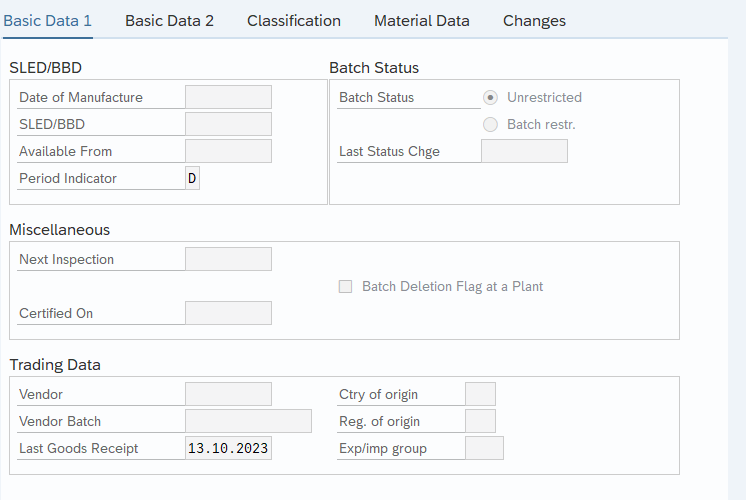
To change an existing batch: MSC2N. To display it in read-only mode: MSC3N. Consistent with SAP naming conventions, you find the suffixes 1N / 2N / 3N on many transactions (create / change / display).
Automatic creation at goods receipt: MIGO
In most projects, batches are not created by hand. They are born automatically at the moment of the physical receipt (goods receipt) or the production order confirmation. During a 101 movement (receipt against a purchase order) in transaction MIGO, SAP opens the batch entry screen and allows you to create it on the fly.
The configuration of the automatic assignment is done in OMCZ (numbering scheme). The classic options: batch number provided by the user, internal assignment via a number range, inheritance of the vendor batch number. To be discussed with the warehouse team before locking the choice, because it is the first thing the forklift operators will type during entry 50 times a day.
And then? How SAP chooses the batch to consume
You have activated batch management. You have created your first batches. You have 200 batches of paracetamol in stock, all valid. When a production order needs 50 boxes, which one should SAP consume?
This is where an advanced mechanism called batch determination comes in. SAP applies a business rule that you have configured: FIFO (first in, first out), LIFO (last in, first out), nearest expiration, batch with compatible characteristics, etc. The engine automatically selects the right batches, proposes the quantities, and confirms.
The configuration of batch determination is denser than what we have seen so far. It involves advanced Customizing objects (condition tables, strategies, sort rules, search procedures). If you want to configure batch determination end to end, I have detailed it in a dedicated guide: SAP Batch Determination: configuration guide and real-world traps. There we cover the six clean steps and the traps that cost days on a project.
Batch management in SAP is not just one feature among others, it is a structural decision that commits the traceability, compliance and quality of the whole organization. The good news: the basic configuration remains accessible to a junior consultant, the trap mainly comes from the initial choice of level (OMCT) and from the cross-module coordination with PP, QM and SD. If you are starting on a pharma or food project, ask your project manager what the batch level is, it will tell you the flavor of the engagement in two seconds.
Frequently asked questions
What is a batch in SAP?
A batch in SAP is a quantity of the same material that shares common characteristics (production date, vendor, manufacturing conditions) and that receives a unique identifier. The batch makes it possible to trace this subset of a material throughout the supply chain, from goods receipt to customer delivery.
What is the difference between a batch and a serial number in SAP?
A batch groups several units of a material produced under the same conditions, for example 1,000 boxes of medicine from the same production run. A serial number identifies a single physical unit, for example a server or a car. A material can combine both: a batch number for manufacturing and a serial number for each delivered piece.
In which SAP modules is batch management used?
Mainly MM (Materials Management, master data and stock), PP (Production Planning, production orders), QM (Quality Management, quality inspections by batch) and SD (Sales and Distribution, delivering the right batch to the customer). WM and EWM also use the batch number for physical management in the warehouse.
How do you activate batch management for an SAP material?
In transaction MM02, open the material master, go to the Storage 1 view, tick the “Batch management” box then save. From that moment, all goods movements for this material will have to specify a batch number. To activate in bulk, transaction MASS on field MARA-XCHPF does the work.
At which level are batches managed in SAP?
SAP offers three levels: client level (one unique batch for the whole client, deprecated), material level (one unique batch per material number, recommended by SAP) and plant level (one unique batch per material and plant combination). The configuration is done in transaction OMCT and conditions the entire system, so it should be locked at the very start of the project.
What is the difference between batch management and batch determination in SAP?
Batch management is the basic mechanism that lets you create, identify and store batches in SAP. Batch determination is an advanced function that lets SAP automatically choose which batch to consume according to business rules (FIFO, LIFO, nearest expiration). You can activate batch management without batch determination, but not the other way around. To configure determination, see our dedicated guide.
Keep reading
SAP batch determination and management
You are configuring SAP batch determination and the engine does not kick in. You are picking batches in the wrong order even though the sort rule is correctly set up....
 Pierre B.
SAP Serial Number: OIS2 setup and material vs equipment
A SAP serial number is the unique identifier attached to one specific physical unit of a given material. It is the tool for unit-level traceability, the foundation for individualized after-sales...
Pierre B.
SAP PRT: Production Resources and Tools
On an industrial site, the tools shared between production lines are often invisible in SAP. Jigs, probes and technical drawings move from one order to the next, but nobody knows...
Pierre B.
SAP Classification System: characteristics and classes
You are looking for every high-criticality 24V piece of equipment in SAP. Every batch with a viscosity between 200 and 250. Every premium customer in a specific geographic area. If...
Pierre B.