
Many PP teams activate an MRP area as soon as they see a need for fine-grained planning, when what they usually lack is a good strategy setup at plant level. The MRP area is powerful. It also splits planning irreversibly on the operations side, and it carries a real operational cost for warehouse and supply teams. So it pays to know exactly when it becomes unavoidable before activating OM01. In 2026 on S/4HANA, the question gets even trickier: MRP Live recalculates fast, but its power does not fix an MRP segmentation that was wrongly set up at the start.
- The MRP area segments requirements planning below the plant level, at a finer granularity. Three types are available:
01Plant,02Storage Location,03Subcontracting. - Activation is done through transaction
OM01and stores the settings in tableMDLV. An irreversible action in production. - Material assignment goes through
MM02MRP 1 view, “MRP Areas” button. The material-to-MRP area link is stored inMDMA. - In S/4HANA, MRP Live (transaction
MD01N) processes MRP areas in-memory. Check pMRP compatibility with your release before promising a simulation to the business. - Decision before go-live: Plant to steer a complete industrial unit, Storage Location to isolate an advanced warehouse or a remote site, Subcontracting for a dedicated supplier.
Why plant-level planning quickly hits its limits
Standard MRP calculates requirements at the plant scale. That is consistent when the plant is homogeneous and all materials follow the same procurement logic. Industrial reality almost never looks like that.
Three very common situations break this single-plant model:
- An advanced warehouse steered differently. Part of the stock of a given material lives in an EWM kanban zone with fast consumption, while the rest stays in the central warehouse with classic replenishment. At plant level, MRP sees a total, calculates a single order date, and breaks the kanban rhythm.
- Multi-supplier subcontracting. The same material is subcontracted to two or three providers in parallel, with different service contracts and lead times. MRP at plant level aggregates, and cannot allocate intelligently.
- A remote site with its own logic. A specific production version runs on a remote site with its own cycle times and its own receiving rules. At plant level, these specifics get diluted.
In these three cases, the MRP area becomes relevant. It allows several coexisting MRP views for the same material, each with its own procurement rules, its own calculation strategies, and its own owners. This is not an ABAP topic nor a technical topic. It is a business design topic.
The 3 MRP area types: decision matrix
SAP offers three MRP area types. The choice drives operational use and setup complexity. Here is the grid I apply on my supply design projects.
| Type | Use case | Key benefit | Limit to know |
|---|---|---|---|
01 Plant | Classic MRP at plant level. Serves as the default fallback. | No specific setup, historical behavior preserved. | Blind to internal zone constraints. Does not cover granularity needs. |
02 Storage Location | EWM advanced warehouse, kanban zone, remote site, differentiated consumption zone. | Allows several MRP policies for the same material within the same plant. | Once assigned to a material, rolling back is heavy, sometimes impossible without stock reprocessing. |
03 Subcontracting | Subcontracting with a dedicated supplier for the same subcontracted component. | Perfect isolation of subcontracting flows by supplier. Dedicated view per contract. | Strictly reserved for subcontracted components. Frequent confusion with MRP area type 02 on mixed cases. |
The reflex on assignment: start by listing the operational business constraints, then choose the type that covers them, rather than starting from the type and looking for use cases to fit into it. The opposite risk leads to MRP areas activated without a genuine need, which complicate the planners’ daily work.
OM01 Customizing and creation in table MDLV
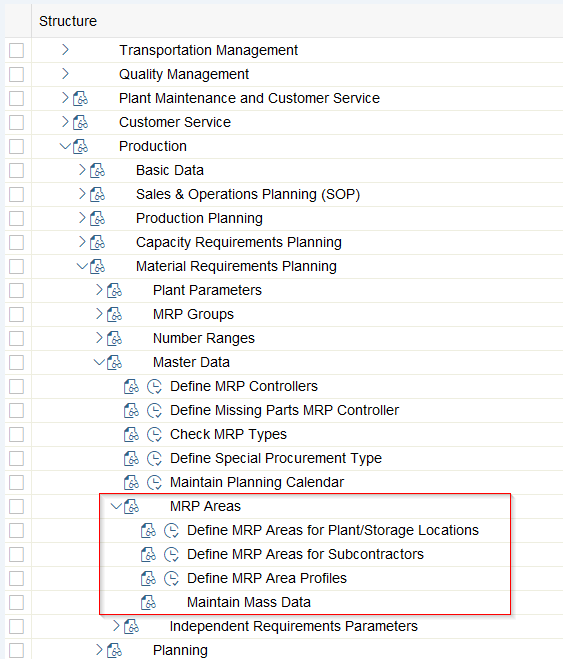
Activating MRP areas is a Customizing transaction with two stages. First stage, activate the feature globally. Second stage, create the concrete MRP areas you are going to use.
Canonical SPRO path:
SPRO → Production → Material Requirements Planning → Master Data → MRP Areas → Activate MRP for MRP Areas (OM01)
Once the feature is activated through OM01, you reach MRP area creation via the “Define MRP Areas” submenu. Each entry creates a row in table MDLV that stores the Customizing. The essential information:
- MRP area identifier, short (typically 10 characters) and descriptive (for example
P001_KANBAN). - Clear functional description that explains the business scope covered.
- Type: 01 Plant, 02 Storage Location, or 03 Subcontracting depending on the need.
- Assigned plant, mandatory.
- Base storage location for type 02, or supplier for type 03.
Save on a transport request so the new MRP area is propagated from the Customizing client to DEV, QAS and PROD. Check the S_TCODE authorizations on OM01 before launching, a classic blocker for juniors during coaching.
Activating an MRP area on a material creates a row in MDMA. Deactivating cleanly means purging the open requirements, handling the residual stock, and aligning the MRP parameters at plant level. On a live system with hundreds of materials, rolling back costs several weeks of work. Decide before go-live, not after.
Material assignment through MM02 and table MDMA
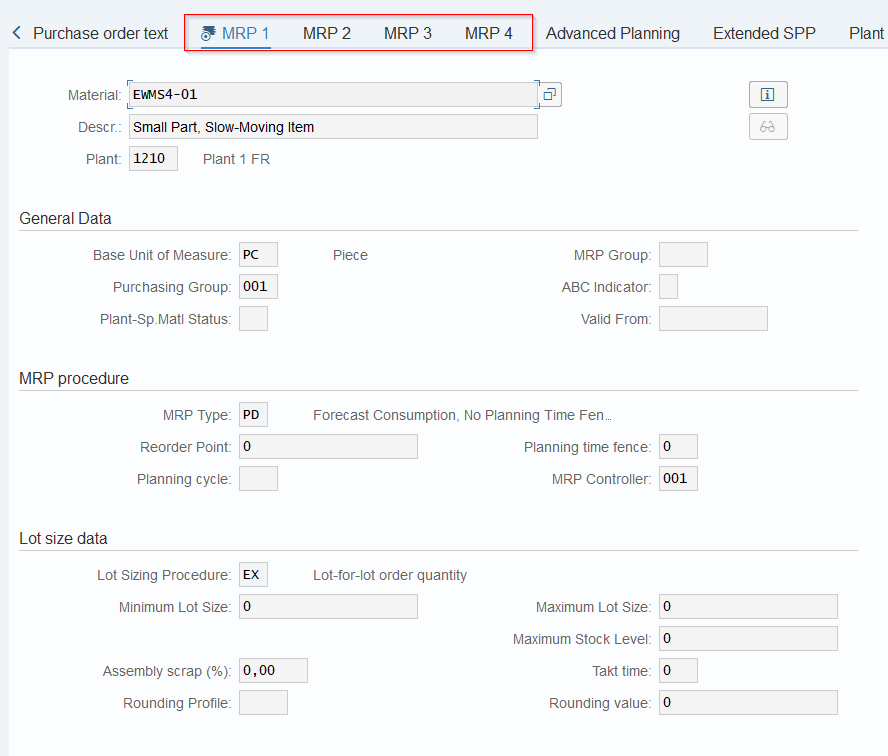
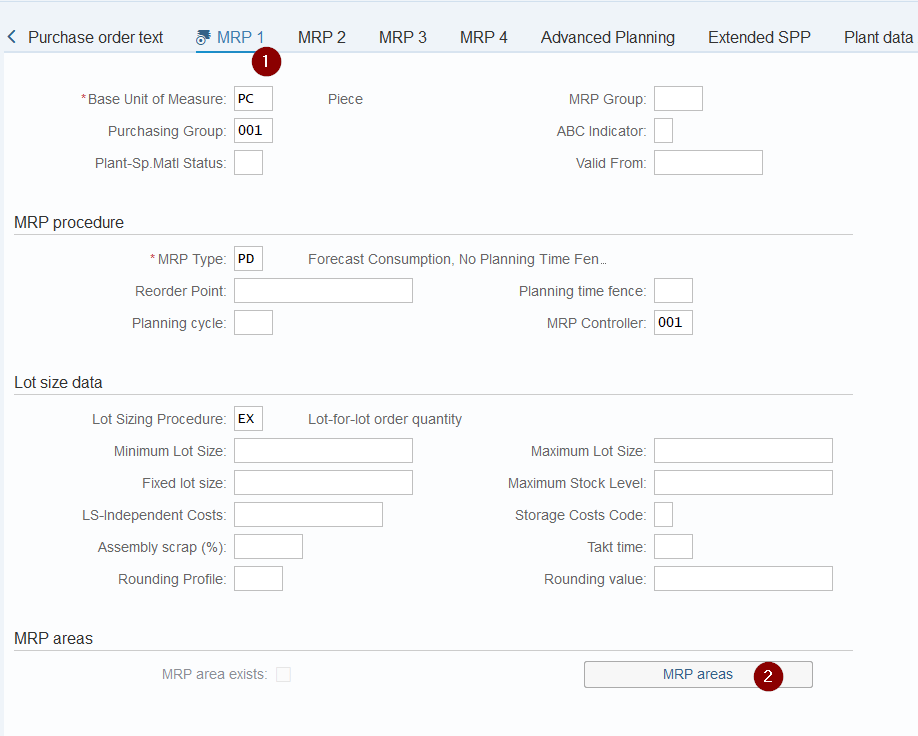
With the MRP areas defined in Customizing, the next step is assignment to the materials concerned. This is done material by material through transaction MM02, MRP 1 view.
Standard procedure:
- Open
MM02on the target material. - Select the MRP 1 view.
- Click the MRP Areas button at the bottom of the screen.
- Choose the relevant MRP area from the proposed list. The selection writes a new entry in table
MDMA. - Once the MRP area is selected, set up the 4 sub-views that appear: MRP 1 (MRP procedure, lot size), MRP 2 (purchasing, scheduling, requirements calculation), Forecast (forecasting), Consumption values (consumption history).
Each assigned MRP area has its own DISPO (MRP controller), which lets you spread operational responsibility across planners. It is a detail that changes daily life: the planner of the advanced warehouse only sees her own orders, not those of the whole plant.
For mass assignments on hundreds or thousands of materials, manual assignment through MM02 is unsuitable. Two industrial options: go through batch input on MM02, or use the SHDB Transaction Recorder to script a dedicated ABAP program. On S/4HANA Cloud, LTMC or a dedicated OData service is preferred.
MRP area in S/4HANA: MRP Live, pMRP and new pitfalls
S/4HANA did not replace the MRP area, it integrated it into two more powerful mechanisms: MRP Live and pMRP. But this integration changes operational behavior.
MRP Live, launched through MD01N, leverages the HANA in-memory database to recalculate planning almost in real time. On a system with 50,000 materials and several active MRP areas, the full run goes from several hours (classic MRP) to a few minutes. Useful for companies that want a daily or even intraday replanning rhythm. The limit to know: MRP Live respects existing MRP areas, but it does not write requirements exactly like classic MRP. Check the error reports in MD04 by MRP area after each run, especially when you start using it.
pMRP (Predictive Material and Resource Planning) lets you simulate scenarios on capacities and stocks. It is powerful for S&OP and tactical planning. The pitfall: depending on the S/4HANA release, pMRP does not cover all MRP area types. Check the compatibility in the SAP Note matching your release before promising a pMRP simulation to your business.
Typical ECC to S/4HANA migration case: the existing MRP areas in ECC are kept as is. The risk is failing to leverage MRP Live to rationalize some MRP areas that have become useless with HANA performance. An MRP area audit as part of an SAP S/4HANA rollout lets you clean up what ECC had imposed by performance constraint and that no longer has any reason to exist.
On my recent S/4HANA projects, the MRP area remains a business design topic, not a technical topic. The real question is not how to activate it in OM01, it is whether you really need it before freezing a split you will drag along for ten years.
Michael Antoine, SAP EWM / Supply Chain / S/4HANA consultant
Frequently asked questions about the SAP MRP area
Can you deactivate an MRP area once activated on a material?
Technically yes, by deleting the row in table MDMA through MM02 and realigning the MRP parameters at plant level. Operationally, it is heavy. All open requirements must be purged or reprocessed, the residual stock per MRP area handled, and the DISPO controller reassigned. On a live system, several weeks of work. Decide before go-live, never after.
Are the MRP area and MRP Live compatible in all S/4HANA releases?
MRP Live has supported MRP areas since the first S/4HANA releases, but the detailed behavior evolves. Check the SAP Note for your exact release, in particular on type 03 Subcontracting MRP areas. For pMRP, coverage is more partial: some releases only simulate type 01 and 02 MRP areas.
Difference between Storage Location MRP (MRP 4 view) and MRP area type 02?
The MRP 4 view allows you to exclude or plan a storage location separately with very limited settings. The MRP area type 02 goes much further: it allows a full MRP policy with its own MRP 1 to 4 parameters, its own DISPO controller, its own forecasts. The MRP 4 view remains useful for simple cases (excluding a quarantine warehouse, for example). The MRP area type 02 is the tool for complete planning policies.
Is the DISPO controller specific to each MRP area?
Yes. Each MRP area assigned to a material through MDMA can have its own DISPO. That is precisely the operational benefit: the planner of the advanced warehouse only sees their own orders, not those of the whole plant. It also lets you measure MRP performance per owner.
Do you have to redo OM01 in each client (DEV/QAS/PROD)?
No. OM01 is a Customizing transaction. The settings are stored in table MDLV and propagated through a transport request from the Customizing client to DEV, QAS and PROD. The global activation and the MRP area definitions follow the standard SAP transport path.
In summary: the MRP area, a supply design tool before being a technical topic
The MRP area is a powerful lever when the business need justifies it, and an operational trap when it is activated by technical reflex. On S/4HANA in 2026, its power is amplified thanks to MRP Live and pMRP, but the decision to activate it remains first and foremost a supply chain design choice. List the real business constraints before touching OM01, validate the operational irreversibility with your business, and only activate what has a clear return on investment. The senior reflex is to start from the need, not from the tool.
Keep reading
Beginner's guide to batch management in SAP MM
I have seen consultants tick the "Batch management" box on thousands of materials in a MASS run, without realizing the batch level was still set at client level. A few...
 Pierre B.
SAP Serial Number: OIS2 setup and material vs equipment
A SAP serial number is the unique identifier attached to one specific physical unit of a given material. It is the tool for unit-level traceability, the foundation for individualized after-sales...
Pierre B.
SAP PRT: Production Resources and Tools
On an industrial site, the tools shared between production lines are often invisible in SAP. Jigs, probes and technical drawings move from one order to the next, but nobody knows...
Pierre B.
SAP Classification System: characteristics and classes
You are looking for every high-criticality 24V piece of equipment in SAP. Every batch with a viscosity between 200 and 250. Every premium customer in a specific geographic area. If...
Pierre B.