The production version is the SAP object that says “to manufacture this material, you combine this bill of materials with this routing, over this period”. On an S/4HANA project, it is no longer optional: without it, MRP Live ignores the material. The topic is not complicated in itself, you just have to know the timing traps and know when to go through C223 or through the mass report.
What is a production version in SAP?
An SAP production version is a master object that combines a bill of materials (BOM) and a routing to define how a finished product will be manufactured over a given period. Created in transaction C223 (Manage Production Versions), it is the reference used by MRP to generate production orders.
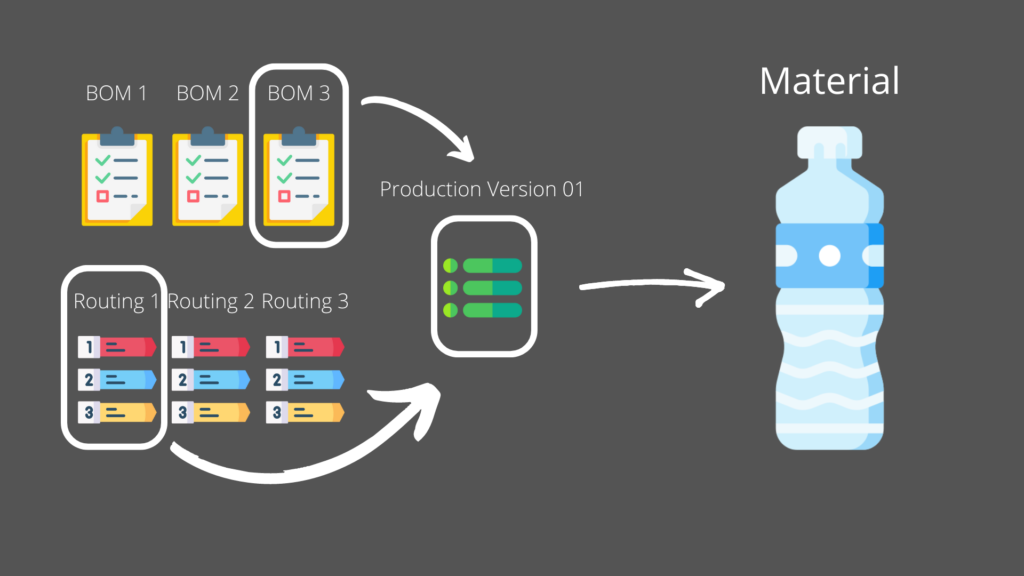
The BOM x routing link
On a complex material, you sometimes have two or three alternative BOMs, and several routings identified by their group counter. Depending on the period or the plant, several combinations remain valid in parallel. The production version serves exactly that purpose: to lock the combination to use when MRP has to decide how to manufacture.
Why it becomes mandatory in S/4HANA
On ECC, the production version was often optional. Standard MRP could do without it by using the Selection Method field in the MRP4 master to choose the default BOM. That era is over.
With MRP Live (introduced in SAP S/4HANA 1610), the production version becomes mandatory for any material managed in planning. Without an active production version in the period, MRP Live ignores the material and generates no supply proposal, unlike the classic ECC MRP which could do without it.
SAP ECC
- Production version optional for standard MRP
- Selection Method (MRP4) active as a fallback
- BOM/routing taken by default if production version absent
SAP S/4HANA
- Production version mandatory for MRP Live
- Selection Method deprecated (field ignored)
- No active production version = no planning
Prerequisites before creating a production version
Before opening C223, three objects must exist and be consistent: the bill of materials, the routing, and their validity periods. If just one of the three is missing or not aligned, the consistency check will fail.
The bill of materials (BOM)
Transactions CS01 to create, CS02 to change, CS03 to display. The BOM lists all the components needed to manufacture one unit of finished product, with their quantities and their validity periods. On a complex material, you often have several alternative BOMs, for example an export version and a local version, or a recipe that changes when you switch to a new generation of raw material. When a component of this BOM is itself batch-managed, it is the batch determination that chooses the batch consumed during manufacturing.
The routing
Transactions CA01, CA02, CA03. The routing describes the sequence of operations (work center, duration, predecessors, resources). Like the BOM, it can have several alternatives identified by a group counter.
Aligning the validity periods
Creating a production version whose validity period exceeds that of the BOM or the routing. The consistency check fails, the production version stays inactive, MRP ignores it. Always check that the production version is strictly included within the intersection of the BOM and routing periods.
Method 1: mass creation via the CS_BOM_PRODVER_MIGRATION report
When you migrate an industrial plant from ECC to S/4HANA, you end up with hundreds of materials to equip with a production version. The standard report CS_BOM_PRODVER_MIGRATION is there for that. It scans the existing BOM/routing pairs and creates the corresponding production versions in a single pass.
- 1Run the report
Transaction
SE38, programCS_BOM_PRODVER_MIGRATION, or via the direct transaction depending on the release. - 2Define the selection
Enter the plant or plants concerned, and the range of material numbers to process. You can filter by MRP controller to scope to a perimeter.
- 3Tick “Test mode”
Always run the first pass as a simulation. The report produces a detailed log without creating any production version.
- 4Check the log
Materials processed, materials in error, reasons (BOM absent, inconsistent periods, etc.). Correct the faulty masters before the real pass.
- 5Run again in real mode
Untick Test mode, run again. The production versions are created with a standard name (often
0001,0002…) and the consistency check runs automatically.
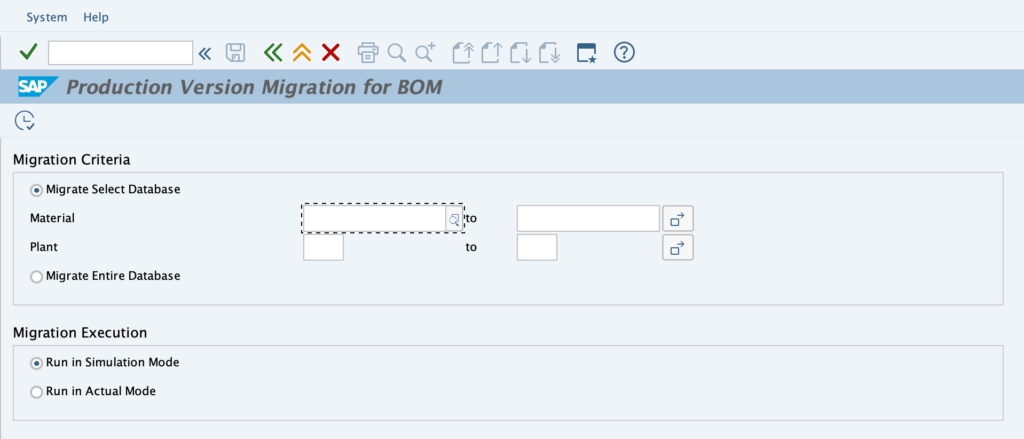
On an S/4HANA project in industry, I migrated a few hundred materials with this report in one afternoon. The difficulty is not the report, it is aligning the BOM and routing periods correctly before running it.
Pierre Balbinot, functional SAP consultant PP/PM
Method 2: manual creation via transaction C223
For a single material or a critical case, manual creation in C223 remains more instructive. All the fields are right in front of you, the consistency check is triggered manually, so when something goes wrong, you identify the cause immediately. It is also where you should start when you are learning the object.
- 1Run transaction C223
Enter the code
C223in the SAP command field (or via the menu Logistics > Production > Master Data > Production Versions). - 2Enter Material and Plant
The finished material concerned and the production plant. Click the “Production Versions” button to list the existing production versions.
- 3Create a new production version
“New Entries” button or click in an empty line. Enter the production version code (4 characters, by convention
0001,0002…) and a short description. - 4Fill in the details
“Details” button: validity period, BOM alternative (often
1), BOM usage (often1= Production), routing group + group counter, lot size min/max. - 5Run the consistency check
Dedicated button at the top of the screen. SAP checks the existence of the referenced objects and the alignment of the periods. Result: green light (OK), yellow (warning), red (error).
- 6Save
“Save” button. A production version with a red check can be saved but stays inactive. To be avoided.
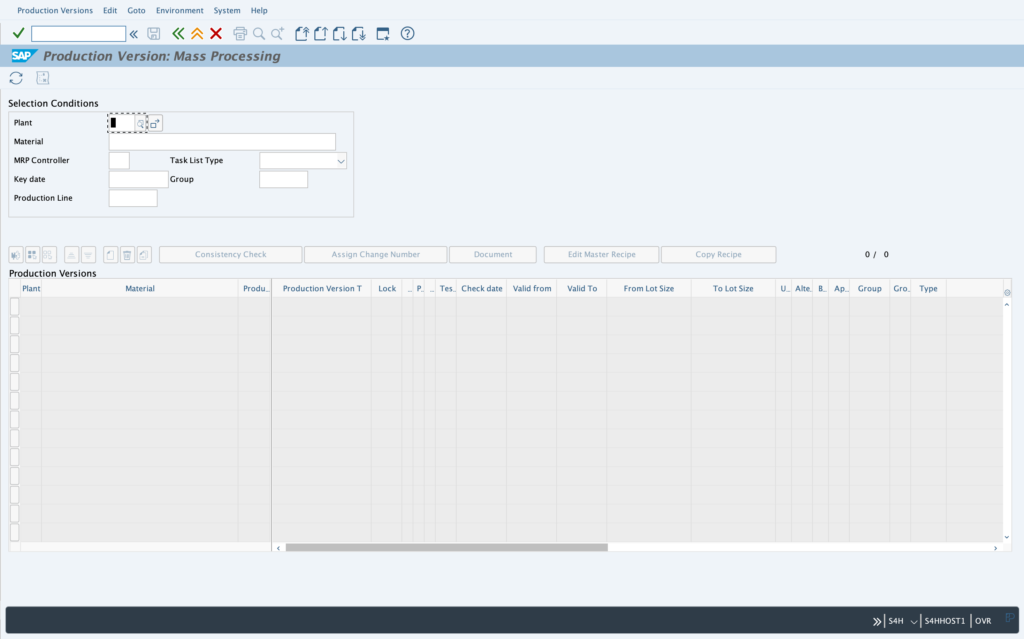
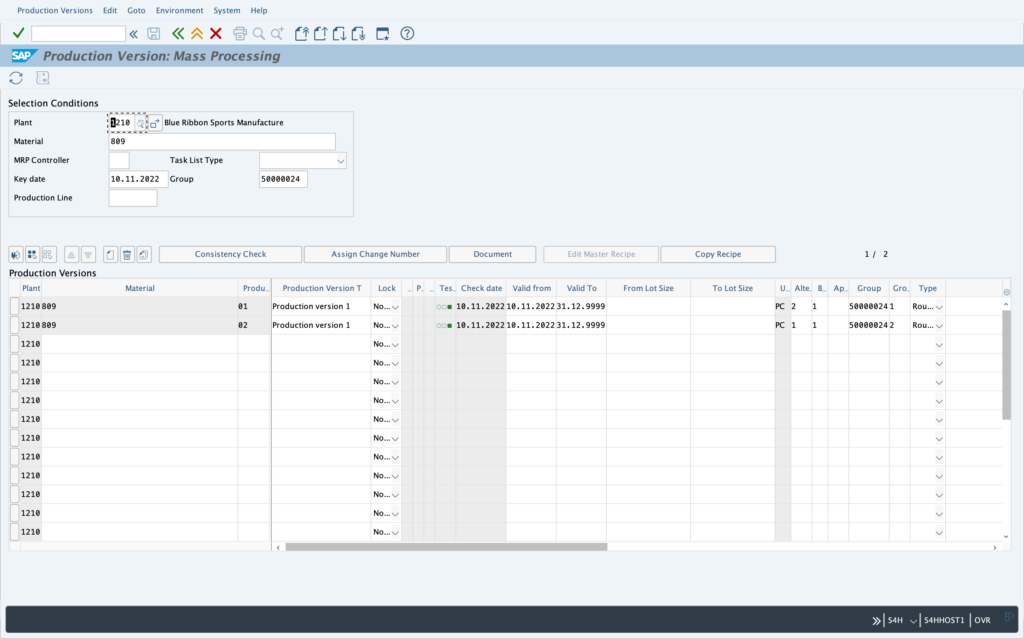
The consistency check
The consistency check is the gatekeeper of the production version. As long as it is red, the production version is inactive: MRP Live ignores it, production orders cannot reference it. Always resolve the warnings and errors before leaving C223.

Referenced BOM or routing absent from the system; production version period exceeding that of the BOM or the routing; BOM usage incompatible with the production version type; production version lot size conflicting with that of the routing.

Setting up the production version in the MRP4 view
Once the production version is created, you still need to check that the finished material master takes it into account properly. This happens in the MRP4 view (transaction MM02, MRP4 tab).
The Selection Method field (deprecated in S/4HANA)
In ECC, the Selection Method field in MRP4 indicated how SAP should choose the BOM (for example 2 = by production version, 3 = by BOM selection ID). With MRP Live (introduced in S/4HANA 1610), the use of this field has evolved: the system favors the active production version declared in C223 rather than the historical Selection Method. If you migrate an ECC material, check that at least one active production version exists before go-live.

Enabling automatic sourcing for MRP Live
For a material to be fully driven by MRP Live in S/4HANA, three conditions must be met: at least one active production version over the current period; BOM and routing referenced in the production version also active over this period; consistency between the production version lot size and the lot-sizing rules of the MRP1 view.
Production version = BOM + routing + period + lot size, locked into one combination. Mandatory in S/4HANA for MRP Live, optional in ECC. Mass creation via the CS_BOM_PRODVER_MIGRATION report, manual creation via transaction C223. Always validate the consistency check before saving. The Selection Method field in MRP4 is deprecated in S/4HANA. To really understand how BOM components are consumed during manufacturing, see also the beginner guide to SAP batch management.
FAQ: SAP production version
What exactly is the SAP production version for?
It combines a bill of materials (BOM) and a routing for a given period, and serves as the reference for MRP to generate production orders. Without a production version, MRP has no way of knowing which BOM to associate with which routing for a material that has several of them.
What is the difference between a BOM and a production version?
The BOM (bill of materials, transaction CS01) lists only the components needed for manufacturing. The production version (transaction C223) combines this BOM with a routing and fixes the validity period of this combination. A BOM can exist without a production version, the reverse is not possible.
How do you activate a production version?
Run the consistency check in C223 and resolve all the warnings and errors until you get a green light. An “active” production version = green check + current date included in the declared period. The “Locked” flag must also be unticked.
Why is my production version not found by MRP?
Four typical causes: validity periods misaligned between the production version, BOM, and routing; Locked flag ticked on the production version; Selection Method field inconsistent with the production version (on ECC only); no active production version at the current date (all expired or not yet started).
Can you have several active production versions in parallel?
Yes. Several production versions can be active at the same time for the same material (for example 0001 and 0002). By default SAP uses the first one in alphabetical order, unless a quota arrangement (transaction MEQ1) or a source list (ME01) defines another selection rule.
Is the MRP4 Selection Method field really deprecated in S/4HANA?
Yes, since the first S/4HANA releases. The field stays displayed for compatibility with masters migrated from ECC, but MRP Live ignores it systematically and uses the active production version. Still on S/4HANA: no active production version = no planning, whatever the value of Selection Method.
How do you automate production version creation across hundreds of materials?
Three options depending on the context. The standard report CS_BOM_PRODVER_MIGRATION covers most cases of an ECC to S/4HANA migration. For more complex rules (business filters, transformations), LSMW remains relevant. For a recurring integration, the BAPI BAPI_PRODVERSION_CREATE allows you to script creation from an external program.
Keep reading
SAP PRT: Production Resources and Tools
On an industrial site, the tools shared between production lines are often invisible in SAP. Jigs, probes and technical drawings move from one order to the next, but nobody knows...
 Pierre B.
Beginner's guide to batch management in SAP MM
I have seen consultants tick the "Batch management" box on thousands of materials in a MASS run, without realizing the batch level was still set at client level. A few...
Pierre B.
SAP batch determination and management
You are configuring SAP batch determination and the engine does not kick in. You are picking batches in the wrong order even though the sort rule is correctly set up....
Pierre B.
SAP pMRP Explained: Predictive MRP in S/4HANA (and How It Differs from LTP)
SAP pMRP is neither one more MRP run nor a quick facelift of LTP. Predictive Material and Resource Planning is a simulation: nothing you do in it touches your operational...
Pierre B.